What Did Your Team Get Done This Week?
Macroscope tells you what got done, who is working on what, and who is shipping what. The simple way to make sense of your engineering team.
$100 free usage. Usage-based pricing, no seat fees.
Macroscope tells you what got done, who is working on what, and who is shipping what. The simple way to make sense of your engineering team.
$100 free usage. Usage-based pricing, no seat fees.
Macroscope Status reads every commit your engineers and AI agents push to GitHub, summarizes each one, and sends engineering managers a weekly email digest. Nobody fills out a form or writes a status update. It costs $0.05 per summarized commit, with $100 in free usage for every new Workspace.
Want it in Slack? Subscribe a channel to commit summaries and PR activity, or schedule a Macro that posts a weekly product update to Slack or a webhook. Engineering analytics platforms such as LinearB, Jellyfish, and Swarmia center on metrics, dashboards, and reports (per their homepages, checked November 5, 2026). Status writes the weekly update itself. Our May 2026 analytics review compares the approaches.
Trusted by engineering teams
Macroscope tells you. Leaders get visibility, engineers get focus.
Get actionable understanding of what's happening. Macroscope tells you what's changing, and answers any of your questions, grounded in the codebase.
More building, less reporting. Macroscope summarizes your commits, describes and reviews your PRs, and explains how the codebase is changing.






Productivity stats for devs and agents. Every commit summarized, every sprint reported, every project tracked.
Every commit summarized in plain English, from engineers and AI agents alike. No more squinting at diffs to understand what shipped.
The weekly engineering update writes itself. Sprint reports, Friday recaps, and digests delivered to Slack so you always know what got done.
Macroscope groups commits by project so you can see exactly where your team's time and code shipped this week, this sprint, this quarter.
Measure engineering throughput in the agent era. See team output with coding agents alongside human commits, all in one view.
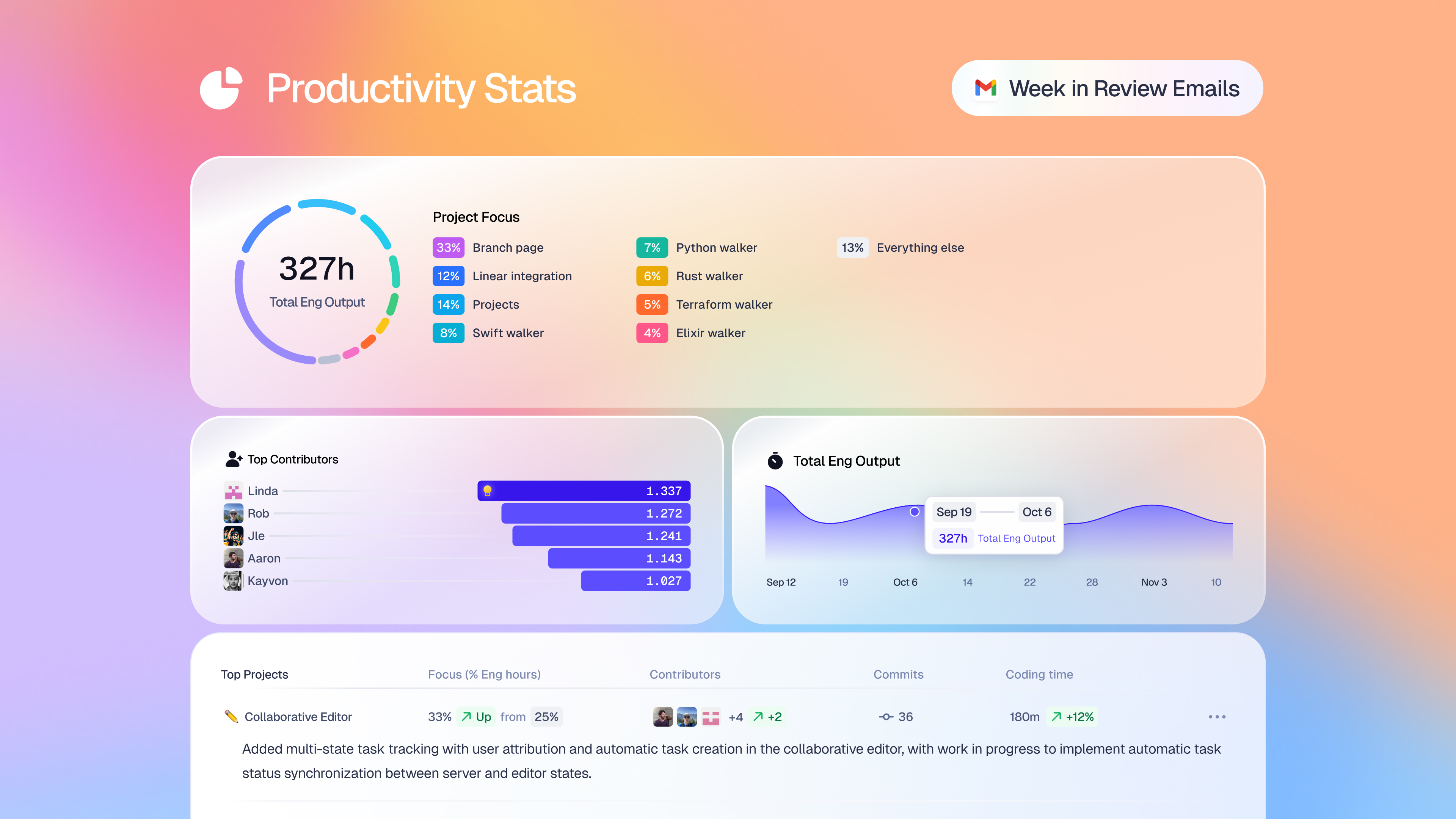
Coding time allocation by project, plus productivity stats for every contributor on your team. Engineers and AI agents, in the same view.
Teams use Macroscope to understand what their engineers and agents are actually shipping.






Usage-based pricing means your costs reflect the work Macroscope does, whether the code was written by a human or an agent.
 Connect GitHub
 and your first weekly engineering update lands in Slack.
Macroscope Status does this from your GitHub commits. It summarizes every commit as it lands, whether an engineer or an AI agent wrote it, and sends a weekly email digest with executive summaries, coding-time trends, and team activity, so engineers never fill out forms or write status updates. Setup: install the Macroscope GitHub app, select Status, write a short Product Overview, and choose your weekly cadence; the initial backfill takes about an hour. It costs $0.05 per summarized commit, with $100 in free usage for every new Workspace. Engineering analytics platforms such as LinearB, Jellyfish, and Swarmia center on metrics, dashboards, and reports; Status writes the weekly update in prose.
Connect GitHub to Macroscope and turn on Status. Macroscope summarizes every commit on repositories with Summarize Commits turned on, and sends a weekly email digest to the recipients you set under Digest Emails, on the weekly boundary you set under Weekly Cadence. Engineers do not write anything.
The built-in weekly digest is an email. In Slack, you can subscribe a channel to commit summaries, PR activity, and build failures, and you can schedule a Macro, such as a weekly product update, that posts a custom summary to a Slack channel or a webhook. Macros run on Agent credits.
Executive summaries, coding-time trends, and team activity, built from commit summaries. If you group work into Areas by product, team, or business unit, each Area gets its own executive summaries and weekly digest. Coding time is an estimate made by an LLM, not a time tracker.
An engineering output dashboard that reads every commit and writes the weekly engineering update for you. It answers what got done, who is working on what, and who is shipping what.
Status connects to your GitHub Workspace and reads every commit, PR, and Jira or Linear ticket. Engineers do not need to fill out forms, write summaries, or attend extra standups.
Yes. Any commit that lands in your GitHub Workspace shows up in Status, whether it was written by a human engineer or an AI agent, so you see total team output in the same view.
Status is built on real commits, not survey-tagged tickets, and it writes the weekly update in prose, not just charts. Pricing is usage-based, not per-seat.
$0.05 per successfully summarized commit, billed at most once per commit. Every new Workspace gets $100 in free usage to start. Usage-based pricing, no seat fees.
About a minute: install the Macroscope GitHub App. Jira, Linear, and Slack are optional and connect separately.
$100 free usage. Usage-based pricing, no seat fees. Engineering output with AI, measured commit by commit.
Get Started Free